
Research & Development
THE SCIENCE BEHIND TCP-25
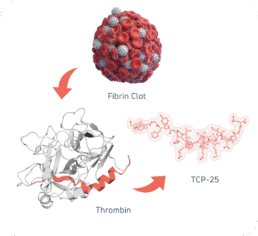
TCP-25 originates from groundbreaking research at Lund University, where Professor Arthur Schmidtchen and team identified a class of thrombin-derived peptides with potent anti-inflammatory and antimicrobial effects. These peptides are part of the innate immune system, the body’s immediate response to injury. By replicating this natural defense mechanism in a controlled, therapeutic form, TCP-25 addresses key drivers of dysfunctional healing at the molecular level.
TCP refers to thrombin-derived C-terminal peptides, short amino acid sequences that occur naturally in wounds and play an active role in the healing process. Xinnate’s lead candidate drug, TCP-25 Gel, is based on one of these multifunctional peptides, known as TCP-25. Its mode of action is well studied and understood, and TCP-25 Gel has demonstrated proven therapeutic effects on infection, inflammation, and healing.
Therapeutic opportunities
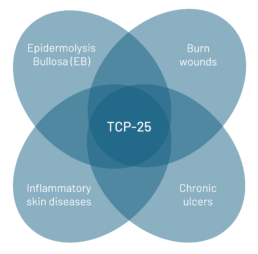
With its multi-modal mode of action that reduce excessive inflammation, reduce exudation, and neutralize pathogenic bacteria, TCP-25 has the potential to address a range of skin conditions, which collectively account for millions of deaths worldwide each year and nearly 4% of total healthcare costs.
Damage to the skin barrier imposes a risk of infection and excessive inflammation, and severe wounds require treatment. Current treatments are not optimal and may increase the threat of antimicrobial resistance (AMR). New efficient treatments are needed that address both harmful inflammation and infection.
TCP-25 Gel is being developed for the treatment of Epidermolysis Bullosa (EB). Venous leg ulcer (VLU) and acute burn wounds are examples of other difficult to heal wounds that would greatly benefit from better treatment options.

Professor Artur Schmidtchen
Modes of action
Dampening the immune response
Binds to PAMPs
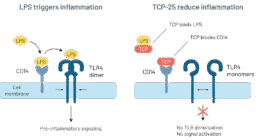
TCP-25 binds specifically to and neutralizes immune stimulating products released from microorganisms (i.e. PAMPs), such as LPS, LTA, peptidoglycan, lipid A, resulting in a reduction of the strong inflammatory response caused by these molecules.
Blocks CD14
TCP-25 also binds to CD14, a receptor for PAMPs expressed on innate immune cells (e.g. macrophages), and blocks the PAMP-binding site of CD14, preventing dimerization of toll-like receptors (TLR) and inflammatory signaling. This leads to down-regulation of excessive levels of cytokines and chemokines (e.g. TNF-ɑ, IL-6, IL-8, MCP-1 and IL-1ß) in wounds, thus promoting normal healing. It also leads to reduction of Heparin Binding Protein (HBP) and the reduction of wound exudation.
Neutralizing microorganisms
Kills bacteria
TCP-25 also has a direct antimicrobial effect by interacting with bacterial and fungal membranes, leading to membrane disintegration, permeabilization and microbial killing. TCP-25 addresses both gram positive and negative bacteria and is also effective on antimicrobial resistant bacteria (AMR).
Preserves immune clearance
Furthermore, TCP-25 does not interfere with bacterial phagocytosis by the immune system, allowing retained phagocytic clearance and reduced bacteria-induced inflammation.
The proprietary gel formulation developed for TCP-25 Gel preserves the multimodal action of TCP-25.
Results
An extensive preclinical development package has been finalized with reassuring results supporting clinical development of TCP-25 Gel. Based on this, TCP-25 Gel entered clinical development with a completed phase 1 study demonstrating its safety and preliminary efficacy in healthy volunteers with induced wounds, patients with large complex wounds (VLU) and patients with Epidermolysis bullosa (EB) wounds.
The efficacy of TCP-25 Gel has been demonstrated in relevant animal wound models of bacterial infection and inflammation and proven to be superior to widely used benchmarks containing PHMB or silver.
Effects of TCP-25 Gel in a wound model
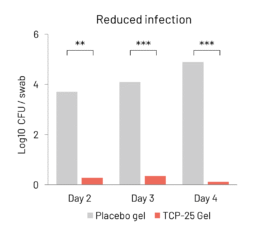
TCP-25 Gel reduces infection
Microbiological analysis of wounds from days 2, 3, and 4 of topical application of TCP-25 Gel in model of induced wounds
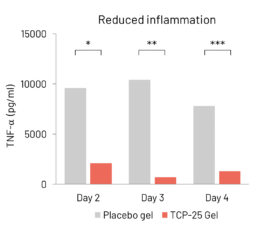
TCP-25 Gel reduces inflammation
Analysis of wound fluid cytokines collected on days 2, 3, and 4 of topical application of TCP-25 Gel in model of induced wounds
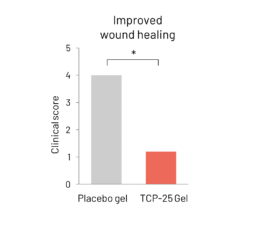
TCP-25 Gel improves wound healing
Clinical scoring of wounds after 3 days of topical application of TCP-25 Gel in model of induced wounds
Reference: Puthia et al., Sci Transl Med. 2020 Jan 1;12(524)
Direct effects of TCP-25 Gel on bacteria
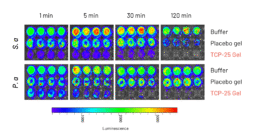
In vitro antibacterial effects of TCP-25 gel
Bioluminescent S. aureus or P. aeruginosa bacteria were incubated with TCP-25 Gel and the bioluminescent signal was analyzed using bioimaging (IVIS Spectrum).
Publications
TCP-25 Gel is built on decades of research and the results have been published in leading scientific journals. See our publications here: